Power and Cement Plants
Used where enclosed conveying improves housekeeping, dust control, and route flexibility within complex plant arrangements.
- Cement plants
- Power plants
- Fertilizer units
- Industrial process plants

Neelkanth Rubber Mills offers pipe conveyor belts for applications where enclosed conveying, environmental control, curve flexibility, and cleaner material handling are important. A pipe conveyor belt forms a closed pipe shape during conveying, helping reduce spillage, limit dust emission, protect the conveyed material, and support plant layouts where horizontal and vertical curves are required.
Pipe conveyor belts are especially valuable in projects where the customer is looking for a more contained conveyor solution for sensitive plant routes, difficult terrain, urban surroundings, or applications requiring cleaner bulk handling. This makes them suitable for techno-commercial projects in power plants, ports, cement plants, mines, fertilizer units, aggregate operations, and industrial bulk handling systems where conventional troughed belts may not offer the same level of enclosure and routing flexibility.
A pipe conveyor belt helps carry bulk material in an enclosed tubular form. This reduces dust loss, limits contamination from outside conditions, and helps protect surrounding plant areas from spillage. It is especially useful where environmental handling standards are higher or where product loss and material escape must be minimized.
Another major advantage is route flexibility. Pipe conveyor systems can travel through horizontal and vertical curves, helping reduce transfer points and support more practical layouts in difficult plant conditions. This makes the pipe conveyor belt a strong solution where both technical performance and project practicality matter.
A pipe conveyor belt is a specially designed conveyor belt that is transformed from a flat shape into a closed pipe shape during operation. This enclosed form allows the belt to carry bulk material in a contained manner, helping reduce dust generation, minimize spillage, and protect the conveyed product from rain, wind, and external contamination. Once the material reaches the discharge zone, the belt opens again to release the product before returning for the next conveying cycle.
Pipe conveyor belts are used in applications where route flexibility, environmental control, and cleaner bulk handling are important. They are commonly selected where the conveyor needs to negotiate horizontal and vertical curves, where surrounding space is restricted, or where transfer points must be minimized. For many techno-commercial projects, a pipe conveyor belt offers a practical solution that combines material containment, reduced maintenance related to spillage, and better suitability for difficult conveying routes.
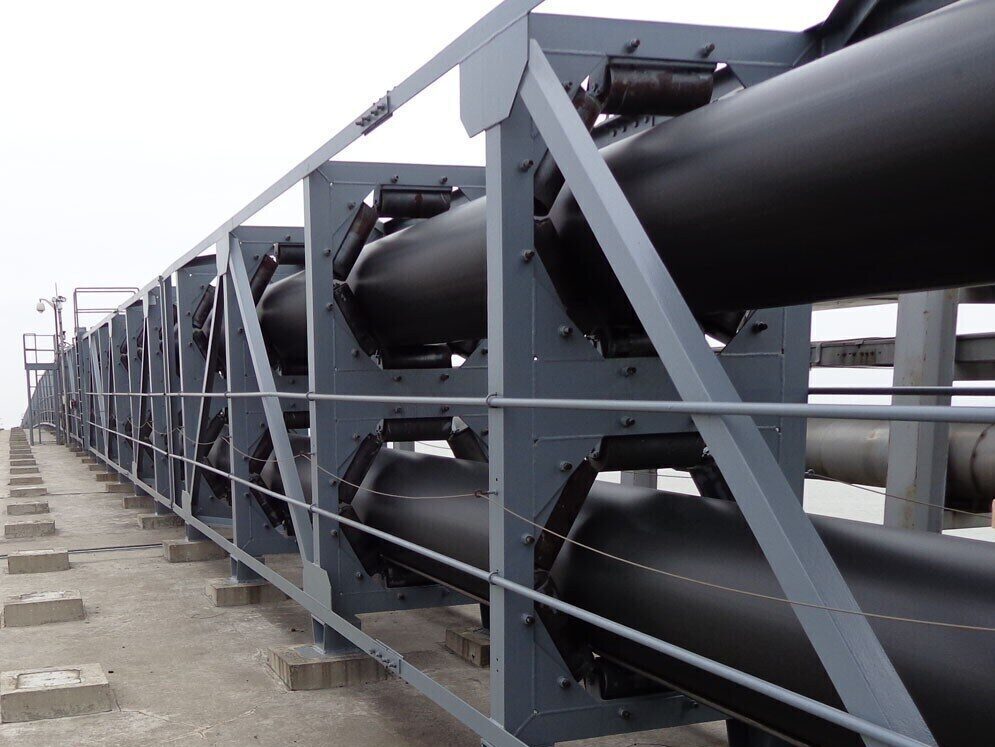
Pipe conveyor belts are important where the conveying system must do more than simply move material from one point to another. In many projects, the customer also wants cleaner operation, reduced dust escape, lower spillage, fewer transfer stations, and the ability to run the conveyor through curved paths. A fabric pipe conveyor belt helps address these needs by enclosing the material within the belt during transport. This makes it a strong option for plants where environmental conditions, plant layout, and route complexity are major factors in conveyor selection.
Used where enclosed conveying improves housekeeping, dust control, and route flexibility within complex plant arrangements.
Preferred where material containment, curved conveying, and reduced spillage improve the overall project practicality.
The enclosed pipe shape helps contain fine material and limit dust escape during conveying.
Material remains enclosed inside the pipe form, helping improve housekeeping and reduce product loss.
The system can travel through horizontal and vertical curves, allowing more flexible conveyor alignment.
Can reduce transfer points and support more compact or obstacle-sensitive plant routing.
Suitable where dust control and material containment are important during transport.
Used where route flexibility and enclosed conveying improve commercial and operational performance.
| Nominal Pipe Diameter (mm) | Belt Width (mm) | Conveyed Quantity (m³/hr) @ 1 m/sec at 75% Fill Factor | Conveyed Quantity (m³/hr) @ 1 m/sec at 60% Fill Factor | Maximum Lump Size (mm) |
|---|---|---|---|---|
| 150 | 600 | 45 | 36 | 40 |
| 200 | 700 | 85 | 68 | 60 |
| 210 | 750 | 95 | 75 | 65 |
| 220 | 800 | 100 | 80 | 70 |
| 250 | 1000 | 130 | 104 | 80 |
| 300 | 1100 | 190 | 150 | 90 |
| 350 | 1300 | 260 | 205 | 110 |
| 400 | 1500 | 340 | 270 | 130 |
| 450 | 1600 | 430 | 345 | 140 |
| 500 | 1850 | 530 | 425 | 160 |
| 550 | 2000 | 640 | 510 | 180 |
| 600 | 2200 | 760 | 605 | 200 |
| 650 | 2400 | 895 | 715 | 210 |
| 750 | 2500 | 1190 | 950 | 230 |
For fabric pipe belts, a practical quick guideline is often expressed in relation to the outer pipe diameter.
The transition from flat to pipe form and from pipe back to flat must be properly designed for stable operation.
Neelkanth Rubber Mills focuses on practical conveyor belt solutions that align with application needs, route conditions, and long-term operating performance. For pipe conveyor belt projects, the objective is not only to supply a belt, but to support a conveying solution that addresses containment, layout flexibility, and dependable operation in real plant conditions.
Whether the requirement is for dusty material, long route conveying, environmentally sensitive handling, or a curved pipe conveyor arrangement, we aim to support customers with a techno-commercial understanding of the application and a more practical belt selection approach.
Pipe conveyor belts are generally selected where the project requires a more enclosed conveying route and where ordinary open troughed belts may lead to unacceptable dust loss, spillage, or route limitations. These conditions are common in plants handling fine or dusty materials, in routes passing through sensitive surroundings, and in projects where curves are needed to navigate plant structures, terrain, roads, or other obstacles.
In practical use, the correct fabric pipe conveyor belt should be selected by considering conveyed quantity, lump size, pipe diameter, belt width, transition distance, and route curvature. A well-selected pipe conveyor belt can help improve material containment, reduce housekeeping issues, and support more efficient project layouts where containment and flexibility are as important as capacity.
Get in touch with Neelkanth Rubber Mills for pipe conveyor belts designed for enclosed bulk handling, reduced dust emission, flexible routing, and cleaner conveying performance. Share your capacity, material, lump size, route profile, curve requirement, and operating conditions for a more accurate recommendation.
